Ovēa Guides · IUD Edition
The IUD conversation
you didn't get in the room.
“It was a ten-minute appointment. I left with an IUD and a pamphlet, and a lot of questions I didn't know to ask.”
An IUD is one of the most effective forms of birth control available, and for many women it's a very good fit. It also deserves a fuller conversation than most appointments have time for. This guide covers the two types, what each tends to do to your cycle, and the risks that rarely make it into the consult, written from 19 years of looking at IUDs on ultrasound.
⚠ Educational resource only. Not medical advice. Contraceptive decisions, and any symptoms you're having with an IUD in place, belong in a conversation with your licensed healthcare provider.

Two devices, two very different
experiences of your cycle.
Most assume “IUD” is one thing across the board. It isn't. A hormonal IUD and a copper IUD work differently, feel different month to month, and suit different priorities. Knowing which is which is the first step to a decision that's actually yours.
Section 01 · The Two Types
Hormonal or copper.
Start with how each one works.
“Nobody told me there was more than one kind.”
Both are small T-shaped devices placed inside the uterus by a clinician, both are more than 99% effective, and both are fully reversible, with fertility typically returning quickly after removal. The differences are in the mechanism and in what happens to your period.
Provides: Progestin · levonorgestrel
Hormonal IUD
Mirena · Liletta · Kyleena · Skyla
Releases a small, steady dose of progestin directly into the uterus. It thickens cervical mucus so sperm can't get through and thins the uterine lining. Most women continue to ovulate, particularly on the lower-dose devices.
Pros:
- Periods usually become lighter and less crampy over time; some stop altogether
- The higher-dose devices are also used to treat heavy menstrual bleeding, and are often offered for endometriosis or adenomyosis symptoms
- No estrogen, so it's an option for many women who can't take combined pills
- Nothing to remember day to day
Cons You may not know about:
- Unpredictable spotting is common for the first 3 to 6 months
- Some women report hormonal effects such as acne, breast tenderness, headaches or mood changes, even though blood levels of the hormone are low
- Ovarian cysts may show up more often
- Your bleeding pattern stops being a reliable prediction of your natural cycle, and it may take longer to become pregnant after removal for several cycles
Hormone-free option
Copper IUD
Paragard · Miudella
Contains no hormones. Copper released into the uterus makes the environment hostile to sperm, so fertilization doesn't happen. You continue to ovulate and cycle on your own rhythm.
Pros:
- No hormones at all; your natural cycle and ovulation carry on
- The longest-lasting reversible option
- Can be placed as emergency contraception within 5 days of unprotected sex
- Cycle tracking by bleeding, temperature and cervical mucus still works
Cons you may not know about:
- Periods are often heavier, longer and more crampy, especially in the first 3 to 6 months, and for some women that never fully settles
- Heavier bleeding can pull your iron stores down over time if they were already low
- Not suitable with a copper allergy or Wilson's disease
- Usually not the first choice if your periods are already heavy or painful
Section 02 · Cycle Expectations
What your period is
likely to do.
“Is this normal, or is something wrong?”
Most of the worry in the first year comes from not knowing what the adjustment period looks like. These are typical patterns. Individual experience varies, and a change that arrives after things had settled is worth more attention than one that was there from the start.
| Hormonal IUD | Copper IUD | |
|---|---|---|
| First 3–6 months | Irregular spotting or light bleeding on many days. Cramping that eases over the first weeks. | Heavier, longer periods and stronger cramps. Some spotting between periods. |
| By 6–12 months | Bleeding usually much lighter. Around 1 in 5 women on the higher-dose devices have no period by one year; fewer on the lower-dose ones. | Often eases, but periods commonly stay somewhat heavier than they were before. |
| Ovulation | Continues for most women, though some cycles may be suppressed, more so on higher doses and in the first year. | Unchanged. |
| Cycle tracking | Bleeding no longer tells you much. Temperature and ovulation tests still can. | All the usual signs still apply. |
| After removal | Fertility typically returns quickly with either type. A cycle that was irregular before the IUD will usually be irregular after it. | |
Section 03 · The Lesser-Discussed Risks
Uncommon is not
the same as unmentionable.
“If I'd known that was a possibility, I would have called sooner.”
Serious problems with IUDs can happen, and most women don't know the signs. Here's to help you-because knowing what to watch for is what turns a rare complication into one that gets caught early.
Perforation
roughly 1–2 per 1,000 insertionsWhat it is
The IUD passes partly or fully through the wall of the uterus. It almost always happens at insertion, though it may not be recognized until weeks or months later. The risk is higher when you are breastfeeding or in the months after giving birth.
How it shows up
Strings that can't be felt or seen, pelvic pain that persists or sharpens after the first few days, or unexpected bleeding. Sometimes there are no symptoms at all. Ultrasound is the first step; an X-ray is used if the device isn't seen in the uterus. A perforated IUD needs to be removed, sometimes by keyhole surgery.
Prolonged spotting
common early · worth a check if it persistsWhat it is
Light, unscheduled bleeding that goes on for weeks. With a hormonal IUD this is the single most common reason women ask for removal in the first year. For most it fades by 3 to 6 months; for a minority it doesn't.
When to ask more
If spotting continues past 6 months, becomes heavy, or returns after a settled stretch, it's reasonable to ask for the position to be checked and for other causes, such as infection, a polyp or pregnancy, to be ruled out rather than assumed to be “just the IUD.”
Irregular periods
expected with hormonal · less so with copperWhat it is
On a hormonal IUD, bleeding can become unpredictable in timing and amount, or stop. This is how IUD's are designed, but it can be frustrating and stressful, and it removes a signal some women rely on.
What gets missed
Because irregular bleeding is expected, new causes of irregularity, like thyroid changes, perimenopause or PCOS, can hide behind it. With a copper IUD, timing should stay regular; a cycle that becomes totally unpredictable deserves the same work-up it would without an IUD.
Pain with intercourse, coughing or movement
not expected once settledWhat it is
A well-positioned IUD shouldn't be felt. A partner noticing the strings is common and easily fixed by trimming. Deep pain during sex, or a sharp pelvic twinge when you cough, sneeze, lift or exercise, is different.
Why it matters
These can be signs that the device is sitting low, has rotated, has an arm pressing into the uterine wall, or is partly expelled. Expulsion happens in roughly 2 to 10 in 100 women in the first year and can be partial and silent. A position check by ultrasound, ideally with a 3D view, answers the question quickly.
Pregnancy
fewer than 1 in 100 per yearWhat it is
No method is 100%. Pregnancy with an IUD is rare, and more likely if the device has shifted or partly expelled without being noticed.
What's different
If pregnancy does occur with an IUD in place, a larger share than usual are ectopic (outside the uterus), even though your overall ectopic risk is lower than with no contraception. A pregnancy in the uterus alongside an IUD carries higher risks of miscarriage and infection. A positive test with an IUD is a same-week call, not a wait-and-see.
- Strings you can no longer feel, or that feel longer or shorter, or the hard tip of the device itself
- Severe or worsening pelvic pain, or sharp one-sided pain
- A positive pregnancy test, or pregnancy symptoms
- Fever, chills or unusual discharge, particularly in the first few weeks after insertion, when the small added risk of pelvic infection is highest
- Bleeding heavy enough to soak through a pad or tampon every hour
- New pain with sex, coughing or exercise after a comfortable stretch
Section 04 · On Imaging
What good placement
looks like on a scan.
“They said it was ‘in place.’ I didn't know what that meant.”
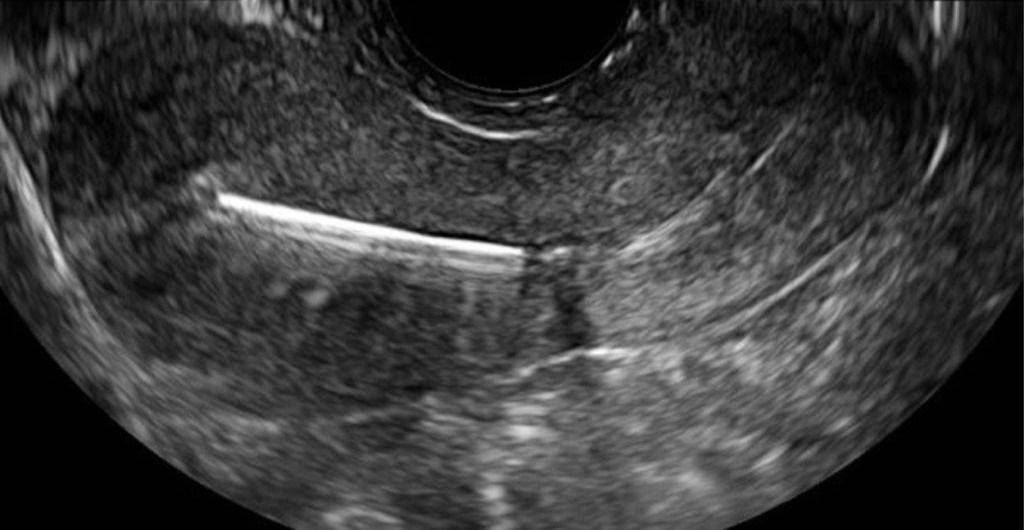
A string check tells you the IUD hasn't fallen out. It doesn't tell you where in the uterus it's sitting. That's what ultrasound is for, and it's the part of this I've spent my career looking at.
What I look for
The stem centred in the uterine cavity with the top of the T sitting high, near the fundus, and both arms open toward the corners of the cavity. A copper IUD shows up bright along its length; a hormonal IUD is subtler and is often recognised by the shadow it casts. A 3D coronal view shows the whole T at once and is the clearest way to see the arms.
What warrants a closer look
A device sitting low in the uterus or in the cervix, one that has rotated, an arm that appears to extend into the muscle wall, or a device that can't be seen at all. Not every imperfect position needs action. Whether to leave, adjust or replace is a clinical decision that depends on your symptoms and your provider's assessment.
Section 05 · A Personal Perspective
Where I land.
One view among several.
Considering the pros and cons to IUD's as a birth control method/ cycle regulation, this last section reflects my own . It's shaped by my training as a sonographer and holistic health coach, and it isn't meant to move you toward an IUD or away from one.
I think of the menstrual cycle as a sign of health, a monthly report on ovulation, thyroid, stress and nourishment. So the questions I'd sit with are less about the device and more about what I'd want to keep hearing from my body.
- What do I want my cycle to tell me? A hormonal IUD can lighten or stop bleeding, which many women welcome. It also means the bleed stops reporting on your hormones. Those hormones are also synthetic, which can make it more unpredictable for your body to regulate itself in terms of getting pregnant later on. A copper IUD keeps that signal, often at the price of heavier periods.
- Why am I pursuing an IUD, and what are my goals? If the goal is to manage heavy bleeding or pain, I'd want to understand what's driving those symptoms as well as how to quiet them. Both can happen together. If it's simply to have a more long term "get it and forget it" birth control method, simply remember that the body doesn't always respond well to a foreign device being inserted into your body.If you have a airly normal and predictable cycle, also look into other natural methods or borth control options that may be gentler.
- How are my iron stores? With a copper IUD and heavier periods, I'd ask for a ferritin level at baseline and again down the line.
- Do I know how I'd get the position checked? I'd want that plan in hand before I needed it.
I highly recommend doing your own personal research, consider ths pros and cons to both options, and feeling confident and confortable with your final decision. Not pushed, rushed, or afraid acting on it. IUDs are definitely an option for an effective reversible contraceptive, and for many women, especially those with very heavy periods, endometriosis or adenomyosis, running to a hormonal IUD can feel like the perfect option to bring relief. Do remember that any hormones that are synthetic will ultimate alter your own hormones receptors, and possibly rob nutrient stores over time, affecting gut biome, and even bone strength. Although rare, copper IUDs cause contribute to “copper toxicity”; Usually this is more of an issue with women who already have underlying issues, have high exposure to copper in everyday life (supplementation, copper pots, etc) but this can lead to overall inflammation in the body, brain fog, and extreme exhaustion. Ultimately, being informed rather than fearful is the best way to go.
The right choice is the one that fits your body, your season of life and your priorities. — Hannah
“Informed isn't the same as afraid. It's knowing what to watch for, and when to ask.”
— Ovēa · Women's Imaging Clarity
“It's in place” is a start.
Seeing where is the answer.
If you've had an ultrasound with your IUD in and were left with a report you couldn't read, an Ovēa Clarity Consult walks you through what the images show about position, the lining and the ovaries, in plain language.
Keep this guide
Take it to your
next appointment.
Save the full guide as a PDF to read later, print, or share with someone who's deciding.
Join Ovēa
You shouldn't have to decode
your own body alone.
Inside Ovēa you can submit your imaging, bring your IUD questions to live Open Hours, and get answers grounded in what your scan actually shows.
Educational disclaimer: This guide is for educational purposes only and does not constitute medical advice, diagnosis, or treatment. It does not replace a consultation with a licensed healthcare provider, and it is not a substitute for the prescribing information for any device. Figures quoted are approximate and drawn from published research and product labelling; individual risk varies. Section 05 reflects personal opinion. Hannah is an ARDMS-certified sonographer and Certified Holistic Health Coach operating in an educational capacity. © 2026 Ovēa · helloovea.com